
'One lesson to emerge out of the Modi-Putin summit is that India can be more self-confident that it possesses inherent strengths to leverage its interlocutors to influence Pakistani policies,' says Ambassador M K Bhadrakumar.

Modi's arrival has changed the optics of the visit. There is a different demonstration of the confidence level in the Indian leadership, but not much has changed beyond that, reports Sheela Bhatt/Rediff.com.

'The Modi government knows that much cannot be expected of Pakistan till the Kulbhushan Jadhav issue is resolved,' says Rajeev Sharma.
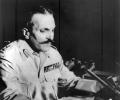
29 years ago this August, Pakistan's dictator, the general who made jihad part of Pakistani State policy, died in a mysterious air crash. Did the KGB, the then USSR's dreaded espionage agency, assassinate Zia-ul Haq? Was India's RA&W responsible for blowing Zia's military aircraft out of the skies? Was it Zia's many enemies in Pakistan's military? Was it a box of mangoes as Mohammad Hanif speculated in his fascinating novel about Zia's death? Or was the assassin someone else?
29 years ago this August, Pakistan's dictator, the general who made jihad part of Pakistani State policy, died in a mysterious air crash. Did the KGB, the then USSR's dreaded espionage agency, assassinate Zia-ul Haq? Was India's RA&W responsible for blowing Zia's military aircraft out of the skies? Was it Zia's many enemies in Pakistan's military? Was it a box of mangoes as Mohammad Hanif speculated in his fascinating novel about Zia's death? Or was the assassin someone else?
29 years ago this August, Pakistan's dictator, the general who made jihad part of Pakistani State policy, died in a mysterious air crash. Did the KGB, the then USSR's dreaded espionage agency, assassinate Zia-ul Haq? Was India's RA&W responsible for blowing Zia's military aircraft out of the skies? Was it Zia's many enemies in Pakistan's military? Was it a box of mangoes as Mohammad Hanif speculated in his fascinating novel about Zia's death? Or was the assassin someone else?

'India in 2020 is a lot better prepared than in 1962.' 'It is no longer a pushover; and anything other than a crushing Chinese military victory will be a major loss of face for China,' observes Rajeev Srinivasan in the first of a three part column.

'The COVID-19 pandemic must push the military into a long-term reconsideration of its primary challenges.' 'There must be greater emphasis on humanitarian aid and disaster relief including the management of contagious illnesses and impending crises caused by climate change,' notes Ajai Shukla.

'It was international diplomacy led by the US that went to the task of talking to these two nations,' he said.
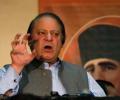
The Sino-Pakistan relationship remains fundamentally asymmetrical: Pakistan wants more out of its ties with China than China is willing to offer. Today, when Pakistan's domestic problems are gargantuan, China would be very cautious in involving itself even more, says Harsh V Pant.

He also said it was important that even during the difficult moments of this "crisis" India has been communicating and engaging with China.

'An authoritative source in the government tells me that India has emerged as the net security provider of the Maldives,' says Rajeev Sharma.

'India must close the missile technology gap with both China and Pakistan as early as possible, or else the credibility of India's nuclear deterrence will remain suspect,' says Brigadier Gurmeet Kanwal (retd).
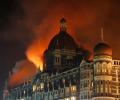
India would have responded differently to "Pakistan-sponsored" Mumbai terror attacks had there been a different "mix of people" at the helm, according to former foreign secretary and national security advisor Shivshankar Menon.

The meeting between Prime Minister Nawaz Sharif and his Indian counterpart Narendra Modi drew mixed reactions in Pakistan, with most of the political parties accusing Sharif of failing to highlight Kashmir but the media was generally positive.

Sushma Swaraj's suave moves helped Narendra Modi pull off a diplomatic coup, helping regain her standing.

Indian High Commissioner in Islamabad Gautam Bambawale met Pakistan Foreign Secretary Tehmina Janjua in connection with the case of Jadhav, who has been given death sentence by a Pakistani military court for alleged spying.

'While the meeting on December 6th was perfectly legal, was it ethical?' asks Colonel Anil A Athale (retd).
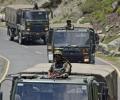
'The one aspect which no Indian military thinker would wish to see emerge is a LoC type of posture at the LAC.' 'The LoC is manned for 750 km and terrorist infiltration has led to the creation of a virtual fortress along its entire length.' 'Something mirroring this at the LAC is going to be expensive although deployment everywhere is not warranted there.' 'However, given the complete trust deficit, there appear few alternatives,' notes Lieutenant General Syed Ata Hasnain (retd).

External Affairs Minister Salman Khurshid on Tuesday said his ministry is contemplating a plan to have people from industry on-board to facilitate on issues relating to economic diplomacy.
China said that decision is in line with the rules of the committee.

In the year since Modi cast the spotlight on Pakistan's human rights violations in Balochistan, India has not done much more than raise the issue at the UN a few times.
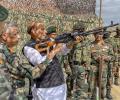
Rajnath Singh believes it would be naive to see disengagement of the armies from the LAC as the end of the trouble. The defence minister has urged the defence forces to be ready for a long haul

Despite the freeze on diplomatic ties between India and Pakistan and protests against the fair, traders at the recently concluded four-day Aalishan Pakistan exhibition did brisk business, reports Upasna Pandey.
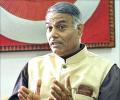
Latching on to the terrorist attack in Pampore that killed eight Central Reserve Police Force personnel, Sinha also said that 'nothing' has come out, or will, of the Centre's Pakistan policy.
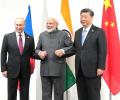
'Russia is the only country that can act as facilitator for any eventual Chinese-Indian rapprochement,' points out Ambassador M K Bhadrakumar.
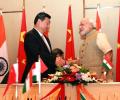
'China's actions at the NSG will certainly taint India-China bilateral relations and enhance suspicion of China's intentions. A fresh clear-eyed and objective evaluation of the India-China relationship is necessary, especially as India tries to correct adversely balanced bilateral economic ties and the two countries engage over the long-term,' says Jayadeva Ranade.

Prime Minister Narendra Modi seems to have secured a rare concession from Pakistan that 'terrorism' and not the issue of Kashmir be the central theme of the India-Pakistan dialogue.
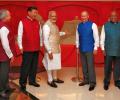
'The crux of the matter is that our narrative lacks credibility with world capitals,' argues Ambassador M K Bhadrakumar.

Do Modi's foreign visits actually serve India or they nothing more than expensive tools for domestic positioning and image-building, asks Shehzad Poonawalla.

The government on Monday faced flak for the Uri terror attack with both the Opposition and the Bharatiya Janata Party's ally in Maharashtra, Shiv Sena taking a dig at Prime Minister Narendra Modi and Defence Minister Manohar Parrikar.

'Today, if the international community is seeking space, if not place, here, then the message is not unclear in any which way. 'It does not reflect well on the nation's standing in the international arena, where human rights issues go a long way in building bilateral relations and benefiting from international cooperation, more than any aspect of politics and diplomacy,' N Sathiya Moorthy.

Former Home Minister P Chidambaram on Saturday attacked Home Minister Rajnath Singh accusing him of resorting to a completely distorting Hindu terror remarks to blame the former UPA government.
Prime Minister Manmohan Singh on Tuesday left for home after an overnight halt here while on his way back from the US where he held talks with President Barack Obama and met his Pakistani counterpart Nawaz Sharif, besides addressing the United Nations General Assembly.
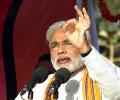
Congress on Tuesday dubbed Prime Minister Narendra Modi as a 'dream merchant', who came to power by selling "false hopes" and dismissed the 100 days of his rule as high on rhetoric and low on performance.

'The Modi government's greatest blunder is to exploit sensitive external relations in its domestic politics,' says Shekhar Gupta.
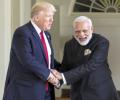
India must be aware that there is no question of the US fighting the Chinese on land. We have to fight our own battles, points out Virendra Kapoor.
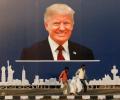
'It's the first-ever US presidential visit which is specially planned for India.' 'The standalone visit itself has achieved something already. Don't underestimate it.' Sheela Bhatt gives us an exclusive glimpse of what the Modi government hopes to achieve from Trump's visit.
